The Fourth Industrial Revolution
Jul 19, 2025
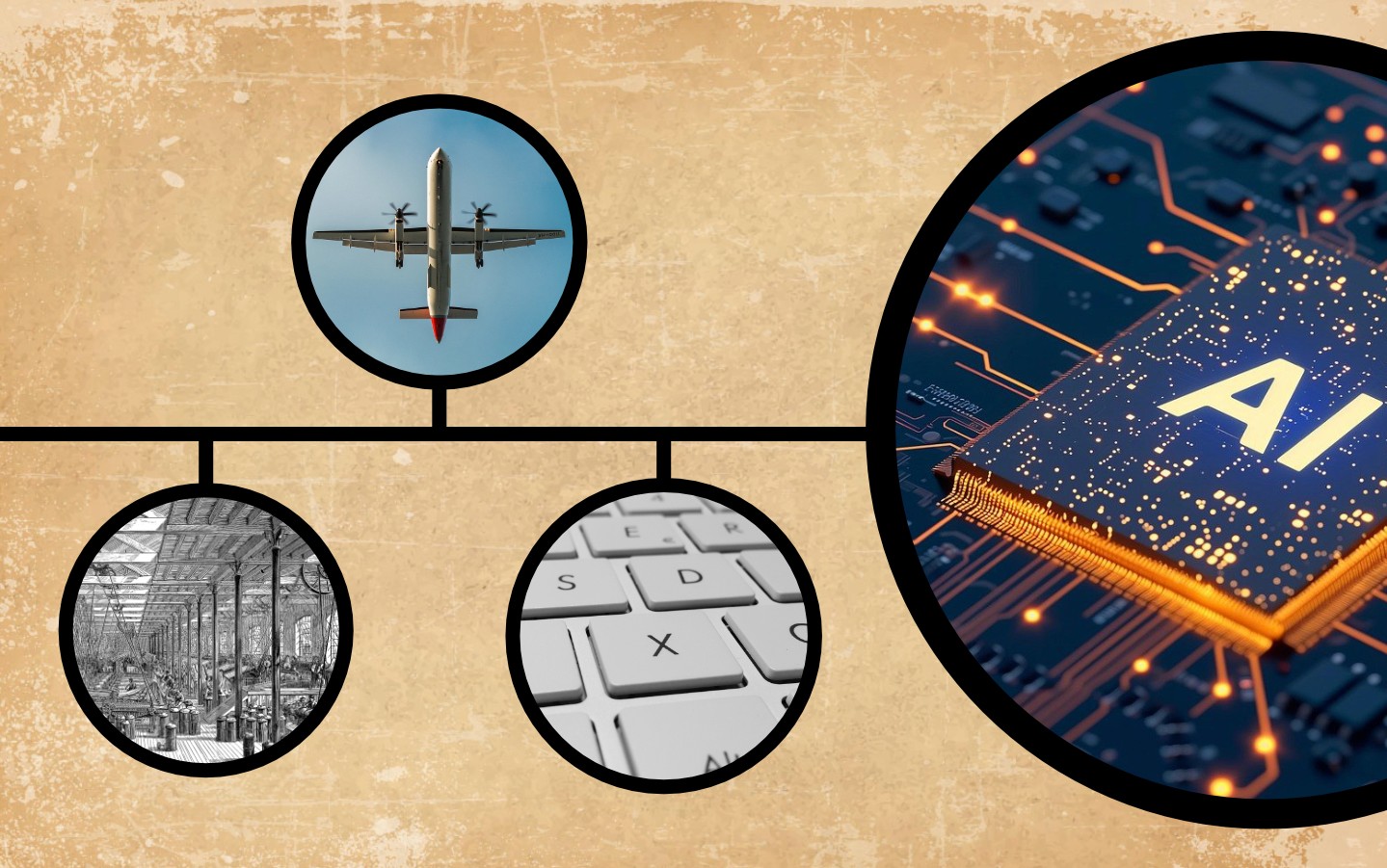
When tracing the technical revolutions of our species we would find a rapid increase in innovation and revolution within the last 200 years. Complicated, timely tasks have become simpler, communication has become incomprehensibly easier, transportation has become more accessible and quicker than ever, and computer technologies have become the fastest-adopted revolution in history. Currently, we are on the brink of a fourth revolution. This time it isn’t the mechanisation of production, leading to factories and mass production and the shift of agricultural societies into industrialised nations and a spread of urbanisation. It isn’t advancements in steel and chemical industries and the growth of transportation networks. It isn’t automation, telecommunication, computers, information sharing or the globalisation of economies. We aren't trying to capture the power of steam or water, implement the life-changing tool of electricity, move ourselves using petrochemical-fuelled machines or expand our potential using internet-connected devices that enable the sharing of information on a scale so great that like the printing press before it, sparked a rebirth of learning in more fields and practices than ever before. No, none of that. Now we are trying to recreate the human brain to undertake tasks and solve problems that are far larger and far greater than anything we could have ever imagined as a species just 10 years ago.
In this article I’m going to delve into what this technology is, how it’s being used, how it could be used, the ethical implications, the compulsory boundaries that must be implemented and how it could benefit our lives in a far greater way than we could ever have imagined.
On the 21st of July 1969, astronaut Neil Armstrong said, as he placed his foot on the surface of our moon, ‘One small step for man, one giant leap for mankind.’ This sentence perfectly summarises the developments made during each technical revolution. Seemingly small discoveries have led to seemingly small developments but together they combine to a great shift in society's thinking and how we function as humans.
The first industrial revolution was spearheaded by the steam engine. A coal-hungry metal machine that provided power on such a large scale that production was changed forever. The second industrial revolution took the power of electricity and petrochemicals to further develop production and transform the transportation industry, moulding the humble steam locomotive into fast and dominant trains, cars, planes and ships. The third industrial revolution saw a different type of energy being used. No longer a physical energy but rather a digital power. New software-powered devices could leverage computing power and digital information releasing and sharing more information than ever before and enhancing communication. Which brings us to the fourth revolution. This revolution doesn't use coal or electricity, but it does build upon the foundation created by the splurge and spread of information during the digital revolution. By creating neural networks – a far cry from the completion of our brains but overwhelmingly powerful – and using the energy of information this new technology is changing our society all over again. Artificial Intelligence is what this technology has come to be known as. Perhaps an overused term but one that has and will continue to radically change our lives, our politics, our society and our futures.
When the steam engine was created many lives were lost because of unsafe working environments and protests broke out due to working hours that were unnatural and employers that abused both women and children. When the power of petrochemicals and electricity was unleashed through transportation safety measures had to be put in place so that it was safe for us to use. Planes were equipped with oxygen masks and other safety devices; cars have airbags and there are laws against how long you can drive to safeguard lives. Many laws have been put in place since the creation of the internet regarding social media. As we start the next journey as a society, coming to terms with the power of AI, the same must take place. Laws must be created, individuals informed and the businesses and people behind the charge restricted as to how to use our information and affect our lives.
However, before we can address these issues it is key to understand what we are dealing with. What is AI? How does it work? What is its energy source? The latter of these questions is perhaps the most important, but it is equally important to understand the fundamentals of this technology.
To put it simply Artificial intelligence is using technology to give computers human-like intelligence. This is done using various tools, techniques, and science and engineering abilities that all come together to form a system which we call Artificial Intelligence. AI is a very powerful tool, but it is only as powerful as the data it is trained on. The data that AI is trained on determines the answers it gives and in the case of Generative AI, determines the media it will create. The term artificial intelligence is an umbrella term for other techniques used to allow computers to undertake simple tasks that subsequently help solve greater problems. For example, Google DeepMind's Alpha fold model uses machine learning which is a specific technique that specialises in pattern recognition. While this is a simple task for us as humans, AI requires access to large amounts of data to be able to complete it. Because of the large amounts of data that this model has access to it can look for patterns and predict the structures of thousands of proteins. This will help us make better medicines and treatments for dozens of illnesses and diseases that people struggle with every day. A basic or developed understanding of AI is sufficient to realise both the potential dangers and possible benefits of this technology.
With each shift and revolution in technology and society, there have been both benefits and downfalls. However good the benefits may seem the downfalls and dangers of the technology in question must be addressed. Before delving into the specific issues surrounding AI, it's good to look back at the past, at the problems faced then and how they were solved. In the early 19th century people's lives were very simple. In many ways, life was like the lives of those living hundreds of years earlier. Agriculture and the creation of goods farming was the centre of life, and everything centred around it. It was the source of people's food and income. However, in the late 1700s due to several factors including an increasing population and a reduction in illness, life expectancy was increasing. Due to longer lives people had more time to think, research and develop things. This era gave birth to many great thinkers who invented machines of kinds that the world had never seen before. Many of the machines that were invented worked by capturing energy that caused a spinning motion. For example, if there was a water source a water wheel could be installed harvesting the kinetic energy. Then many sewing machines could be grouped into a single building to produce more goods and maximise the money going into the pockets of the rich businessmen. This was the birth of the factory, the spark of the industrial revolution. However, the bursting pockets of the rich businessmen didn’t stop the inevitable negatives and dangers from occurring. Despite a sudden boom in money, those who ran the factories still wanted to save money and so often hired orphaned children from government, religious or charitable institutions for almost no pay. The children were forced to work long hours in terrible conditions. As they were still new technologies the dangers of steam-powered machines became apparent. Incidents were extremely common and due to their abundance in the workforce at the time, children were often the victims. One girl named Little Mary Richards was reported to have by a floor manager gotten caught in a machine and the ‘bones of her arms, legs, thighs, etc. successively snap asunder, crushed, seemingly, to atoms, as the machinery whirled her round, and drew tighter and tighter her body within the works, her blood was scattered over the frame and streamed upon the floor, her head appeared dashed to pieces.’ While this is a shockingly graphic description it does give an idea of the horrific conditions that workers in this era of radical change. As a result of this and many other incidents and issues including the creation of new classes, the anger of farmers and others who were left out of the industrialised work life, cruel discipline and health issues protests began. Rightly, angry workers joined together to form unions to fight for better working conditions and higher wages in all settings. This and many other things led to the 1833 Factory Act. While this act did improve conditions for many it did not solve all the problems that workers faced. Protests continued until 1886, and many more factory acts were put into place. Many other types of acts were put into place including the Mines Act of 1842 and acts that addressed specific areas of working life like the 10-hour Act of 1844 which ensured working hours were kept within the scope of what is ethical. This pattern of a new revolution, clear and life-threatening issues being solved and dealt with through intervention is going to reappear time and time again throughout the cycle of revolution.
In response to glaring safety issues within air transport, many acts have been made. While it is hard to show a correlation between new legislation and the rate of aviation deaths, due to a general increase in the use of aircraft, there has been a decrease on average. This would suggest legislation did have positive and necessary effects. As in the first revolution, many of the acts published were a direct result of protests and a reckoning amongst people to the dangers that technology possesses. This pattern continues through the third revolution with the introduction and continued introduction of laws surrounding usage of internet-connected devices, recent restraints around social media platforms and age limits on the consumption of content. Issues plague social media and there is a constant need for change around how smartphones and other such devices can be used. Within the last two years, there has been a great backlash towards the companies behind the social media companies that run the platforms that millions of children and adults use every day. A recent Senate hearing saw the CEO of Meta, Mark Zuckerberg, apologise publicly for content that had appeared on his platform leading to the deaths of many young individuals. While progress may be slow it is taking place and needs to continue to do so in all the areas mentioned so that safer working environments, safer efforts of transport, and more secure online spaces.
Like in past revolutions, this fourth technical revolution also has many issues that make it just as problematic as previous technologies. We are going to look at five of the pressing issues that society faces and regard to this new technology.
As mentioned, each revolution is driven by discoveries and inventions that harness some form of free energy. First it was steam, then electricity and petrochemicals, then a new digital energy or as Steve Jobs put it a ‘free intellectual energy.’ The way Artificial Intelligence works is by accessing lots of information and then working from a prompt it is given to find the best way to a solution based on the data it has access to. AI has access to a lot of information. Like a lot. AI has scraped so much of the internet and every source of information, that the tech giants behind the wave of revolution can legally or illegally gain access to, that now they have begun to scrape the responses that AI itself has given. Having access to this much information is causing many to question what AI might do if it continues to gain access to more information.
One problem that people have is where the AI gets its information from. This is the umbrella issue, all other issues stem from it, and so it is important to understand the problems that we may face in allowing AI to have access to so much information. Firstly, perhaps one of the most dangerous issues is security concerns. With so much information being concentrated in one place, large data sets can be at risk of cyber-attacks. If hackers could gain access to these large data sets, then they could use that information for malicious purposes. While we might think that the risk is low, it is a possibility. If you are a writer, artist, video creator, or music artist or your occupation requires you to create something then it is highly likely that your work could be part of these AI data sets whether you have given consent or not. If you have ever contributed to an online forum, particularly Reddit, then your human conversation may also be part of these data sets. AI models that help answer queries that require access to personal data pose a risk of breaches, leaking people's data and giving it to those who will use it to attack and hurt people. Currently, there are poor government frameworks to protect against such attacks. It would also appear that certain databases and are not compliant with the data protection regulations (GDPR). This means that there is less protection from attacks and weaker transparency on where the data is sourced, how it is used and what data is being used when you query an AI model. Apple has overcome some of these problems when launching its new Apple Intelligence software. Much of the processing for Apple’s new AI features takes place on devices in part due to the powerful neural processing power present in their custom-made silicone. (The M1, M2, M3, and A17 Pro chips). However, for some tasks, access to more data and power is needed and for this, normally you are put at more risk as there is no transparency and security when using these servers. To combat this Apple created ‘Private Cloud Compute’. This aims to protect you and your data when accessing cloud servers that are built using Apple Silicone. They claim that your data is never stored, used only for your specific request and most importantly a verifiable privacy promise. This means that an Apple device will only talk to a service if its code has been made publicly available for experts to analyse and prove that it is safe and secure. While there is scepticism around the truth and motives behind Apple's privacy promise, they are making helpful steps towards making a more private, transparent and secure future in AI. Changes like these need to be taken by more companies harnessing the potential of Artificial Intelligence. There is also a debate that governments should make it compulsory for companies to publish information about the data they are using and how it is being used. These huge data sets often include data about us, things we have made and so it is essential that we push for more transparency and higher security to ensure we are protected. However, it's not just our personal information that these models are being trained on, our photos, our messages, our discussions but it is also being trained on things that artists and writers have created. When tackling the issues of creator's rights two main sub-issues appear. Is it right to use a past artist's work and is it right to use a current artist's work? When you ask an image-generating AI tool for a picture of a dog playing basketball in the style of Leonardo da Vinci the AI model that looks at all the pictures of a dog it has access to, all the pictures of a human playing basketball and all the paintings of Leonardo da Vinci it has access to and in a matter of seconds creates something new. This ability has caused great controversy and yet a human can do the same thing. However, there is a difference. Whilst a human can create something in a certain style to be able to do this they must study and learn to appreciate the style to be able to accurately recreate that artist's unique style. An AI model doesn’t have to do this. It can easily recreate an artist's style without giving the original artist any credit through respect or attribution, things that a human creator might seek to do. However, at the same time, some would argue that using photo editing software, video production software and equipment, and even a keyboard replaces the jobs of hundreds of people from the past and gives people who wouldn’t normally have access to these skills and ambitions the reach to create. The same principles apply to music too. Another key thing to note is that unlike the way a human might create something in a style or that features two things that are not usually seen together by collaging those different elements an AI model creates something completely new based on patterns that it has seen before in the specific things it was prompted to create. This topic is far deeper and far more philosophical than I have covered in this paragraph. It is important to establish the fundamental differences before diving deeper into the laws and ethical questions around this issue. There are three key points: The way humans and AI create is different. This means that the way an AI model work is reacted to by humans will be different. These issues must be addressed by more than just software developers and the tech giants behind the revolution. Another key factor in the issues around AI-created content is how that content is separated from human-created content. This we might call the fight to protect human creativity. Unlike many of the issues talked about, this issue is already well under way to being dealt with. The cContent cCredentials pin is a new mark that shows when an image or another type of created content has been made or edited with AI. However, it does more than this. This pin can appear on all content and is unique because, unlike marks that might appear when you edit a picture using the Samsung Galaxy AI editing tools this appears on all content and contains information about where the content came from and its history. This pin is a big deal for three reasons. Firstly, it continues to push for transparency within the created media generally, not just concerning generative AI but all created content. Secondly, it protects artists' rights over the content they create. For example, the Leica M11-P camera records all the necessary information when a photo is taken. The time the photo was taken, who took it, and how it was taken are all stored and tied that information to the photo in a read-only way. Then when you edit the photo in any editing software that supports content credentials like Adobe Lightroom, the edits you make will be stored so that you can also trace back to the original image. This includes edits that are made with AI tools, and this also applies to images that are made entirely with AI in Adobe Firefly. Currently, there are over 2000 companies that support content credentials, including some of the hardware and software giants like Microsoft and Adobe. Thirdly this helps to protect human creativity by enabling greater transparency but also preserving the history of creation to date and showing the human part in creating the content. Over millennia the way we create as humans has changed greatly. No longer are we painting on cave walls with the juices from squashed berries but rather we are using silicone-powered machines to create artwork, graphics, music, videos and more. The rise in human creativity has never been so great. Creators value their work and there are many laws to ensure that others can do this too. Copyright laws protect the works of creators from being copied and their value subsequently being diminished. The content credentials pin aims to do the same. One key advantage of using AI to generate content is that it can create things that are perhaps unusual and would normally require advanced photo editing and digital collaging skills. To revisit the example used earlier of a dog playing basketball, we could say that for a human to create such an image may be difficult as they must ‘collage’ lots of different images together seamlessly, but also first, they must find appropriate images to collage and sew together digitally. As previously mentioned, an AI when creating an image does not collage parts of images it has access to but rather learns what each element should look like based on thousands of images it has access to and then creates something entirely new. The process AI takes requires no human intervention and because it can be done with speed it doesn’t respect the photographs, vector artists, video creators and music artists that it draws ‘inspiration’ from.’ This ‘lazy’ and easy approach to content creation of any form threatens human creativity. This topic can get very heated very quickly because some would say that these tools are good because they give people capabilities that they otherwise wouldn’t have. It can enable a greater diversity of creation because your skill set no longer matters. However, is this a good thing? If society leans too heavily into this change in the way we create, it could fundamentally change how we see content creation, if we even create content. Ultimately access to an AI Generative tool is available to everyone, at art degrees, college courses, film equipment, and musical instruments are not. How you view this issue is a very personal matter, but I would be inclined to seriously consider how we allow generative AI tools to impact our lives. They threaten overall human creativity, but they also threaten jobs. For artists, job loss is a huge concern because these tools don’t promise the future of ‘AI works alongside humans’ but rather completely replace them and devalue their work. However, this is not the case all the time. When we introduced machines into our workflows and created things on a mass scale, some jobs were left out of the change. These people went through what is known as swing riots where they would damage machines in an act of protest against the change and in anger at being left out of the shift in society. Their jobs weren’t removed but their value was. This pattern has continued throughout history. When electric lambs were invented, lamplights were out of a job. When cars were invented chariot drivers were no longer needed. When telephones were invented, telegraph couriers were no longer needed and later when automated switching systems were invented switchboard operators were no longer needed. When new technologies are created someone loses out. However, in the case of AI, it is often not the case that a job is completely removed, rather it is changed. For example, in the port industry, AI is automating the process of removing cargo from contained ships. While the option to be a crane operator no longer exists, those people are being offered new jobs as managers of the AI system. And it benefits all because it is safer, more efficient and enjoyable for all involved. Also, currently, people can be used to train AI models. For example, a company that is seeking to create fully self-driving trucks employs a past truck driver to help them train an AI to drive the trucks. This seemingly awkward shift could benefit us if again it is done right. We must ensure that creative jobs are preserved so that human creativity is not replaced by a non-conscious sterile piece of silicone that has no feelings, no connection, no true inspiration but we must rather guide AI in a direction of making genuine improvements for our lives. When new technologies are created, there are always some frictions because they aren’t always fair and often, they have widened the divide between the rich and poor, strong and weak and those who come from different cultures, races and personal circumstances. Recently there were issues around bias and incorrect historical depictions that Google's Gemini model seemed to hold when creating images. As this is an extremely sensitive topic, I don’t intend to comment but again problems like this must be swiftly dealt with to make this technology safer and more beneficial for us to use. The last pressing issue is that of privacy concerns. Again, this is a topic on which there is slightly less to comment, but it does raise a concern about AI being used for the wrong reasons. There have been reports that China has been using AI to enhance its face recognition technology and it is confirmed that Israel has been using AI models to tactically choose locations to bomb. These are topics to be discussed by governments, but this is not a good implication and use of AI. Privacy concerns can extend beyond government surveillance into how information is used and processed by AI how it deals with our information and how it deals with sensitive topics. When humans discovered fire it unleashed dozens of new things that they could doinnovations. It was a source of warmth in colder weather, they could cook with it, dry things with it, and it was even a weapon. Likewise, when the power of electricity was harnessed, it enabled us to do thousands of new things, from powering lights in our homes to running machines , and cars. but iIt also could be used to kill individuals. And yet somehow the CEO of Google, Sundar Pichai, would say, ‘I’ve always thought of AI as the most profound technology, more profound the than fire or electricity.’ What is it about this technology that makes some people say this and yet others would sign documents to protect against our species' extinction from this silicon slayer? Many things link AI with the aforementioned technologies and energy sources. AI has and will continue to completely change the ways that we do things as a society. From being implemented into existing technologies like smartphones, laptops, fridges, thermostats and even toothbrushes, to creating new artwork, videos, music and even more forms of media and promising to solve global problems like climate change it is and will continue to have a huge impact on our lives. However, ensuring that this impact is a positive one must be made a priority to not just prevent the science fiction so-called, ‘destruction of the world by robots and AI’ but to protect our creativity and our privacy. The Statement on AI risk document that I mentioned earlier said this, ‘Mitigating the risk of extinction from AI should be a global priority alongside other societal-scale risks such as pandemics and nuclear war.’ This was signed by notable tech figures such as Sam Altman and Bill Gates along with many AI scientists. Like with fire and electricity, there are risks of mass destruction from this technology. With both technologies, laws and restrictions have been put in place to protect us from the risks. The same must happen with AI. It is not a case of allowing the future to write itself because some are and will seek to use this technology for evil purposes and actions must be taken to prevent this happening. How we use AI is also important. Many leading tech companies are using this technology for things which could be labelled as gimmicks or useless features. While many of these run on-device, image generation tools often don’t. There have been studies and reports that show that AI server farms use a lot of energy. One ChatGPT query can use as much energy as keeping a 5W LED bulb on for an hour. It would cause us to question if this is a good use of precious energy resources during growing energy concerns as we continue to try and mitigate the effects of global warming. These are complicated and often philosophical questions, but it is good to consider the answers to create a better future with AI. There are so many problems that AI can help us to solve, and our resources should be put into these so that this revolutionary technology can benefit us all. Each industrial and technical revolution from the past continues. There is a continuous cycle of change and with that change comes the need for laws and restrictions to ensure that with the continued change comes continued safety. There are many good uses of AI to. SoIt can help us solve the issue of climate change, it helps people who suffering with hearing issues and in diagnosing diseases. It can help prevent fraud and optimise slow and inefficient processes. Perhaps there is no hope for a perfect future but at least it can be made as good as possible by ensuring Artificial Intelligence can be, ‘more profound than fire.’ Links:
Content Authenticity Initiative
Crash Course History Industrial Revolution
The Rise of the Machines: Pros and Cons of the Industrial Revolution
Child Labour During the Industrial Revolution
2022 Expert Survey on Progress in AI
MKBHD Waveform Podcast - How Does AI Actually Work
Image by Storme Kovacs from Pixabay
Image by Aristal Branson from Pixabay
Britannica